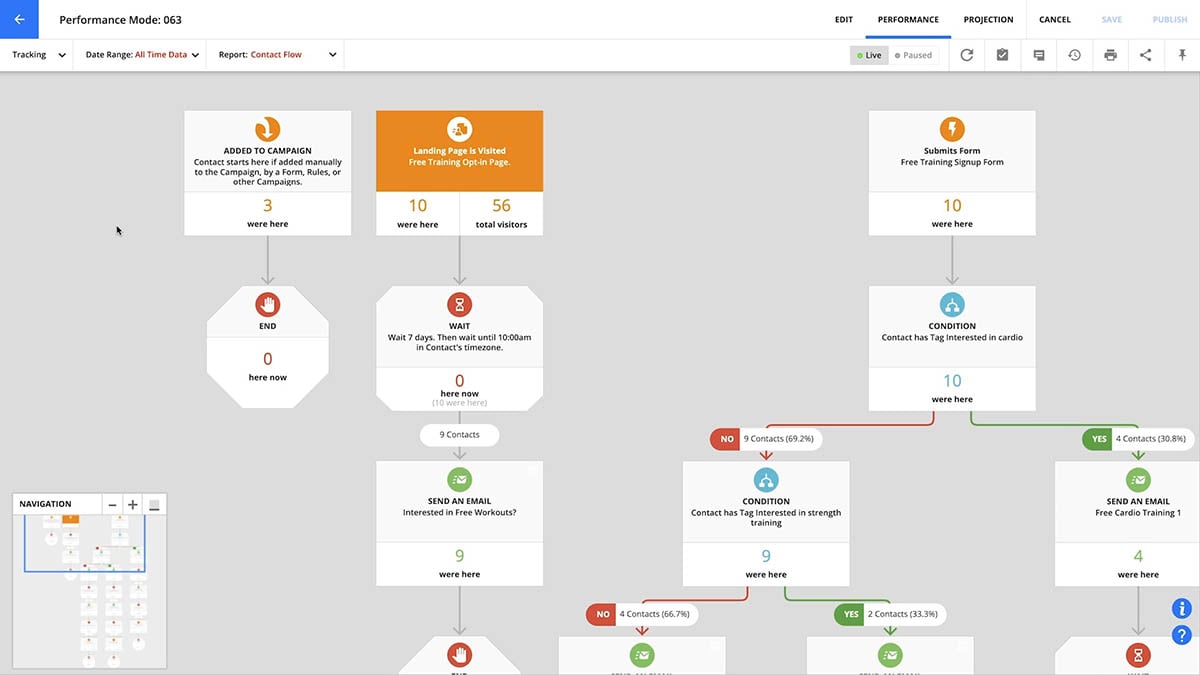
Automate your business calculations to save time and ensure your data is always accurate. You can use equations to automatically track inventory, update capacity limits, or calculate key performance metrics.
Table of contents
Create fields for equations
Set up equations in automation
• Using merge fields in calculations
• Arithmetic operators
Use case
Create fields for equations
To do math in fields, you need to create at least one numeric field first.
You can add up to 3 decimal points to your numeric fields, and more decimal places give you more precise results, but longer harder-to-read numbers.
Here’s some general suggestions for setting up your numeric fields for equations:
Use case | # of decimals | Why? |
Inventory counts | 0 | Whole items can’t be sold in fractions; decimals add no value. |
Average daily sales | 2 | Two decimals allow fractional averages for reporting trends without excess precision. |
Weight-based inventory (kg/lb) | 3 | Three decimals support small weight variations while keeping numbers easy to read. |
Time tracking / billable hours (e.g., task duration) | 2-3 | Using 2–3 decimals allows accurate time totals across many tasks. |
Distance / travel / route tracking (miles or kilometers) | 2–3 | Mileage reimbursement, delivery distances, or service travel logs often need precision beyond whole units. 2 decimals are common for mileage logs (e.g., 12.35 mi), and 3 decimals support short trips or precise route measurement. |
Set up equations in automation
Back to top
Automating your calculations is ideal because actions, such as purchase, can automatically trigger calculations, such as inventory counts, so your data can always be up-to-date without manual work.
- Create a numeric field.
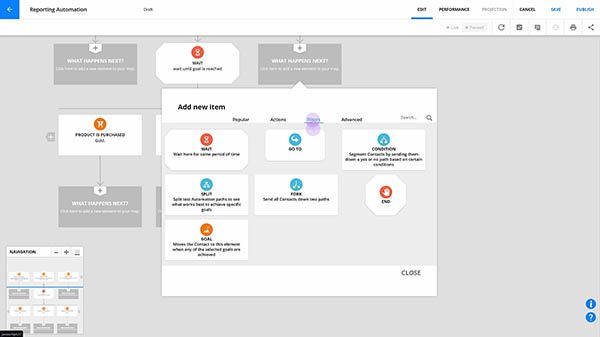
- Create a new automation map or edit an existing one.
- Use the Update element to update your numeric field.
- From the “update this field” dropdown, choose the numeric field that will store your calculation’s value.
- Add your equation into the field below.
- Learn more about formatting equations below.
Using merge fields in calculations
Back to top
Use merge fields in your equations to reference other values in your account. This lets you pull data from numeric fields, price fields, or even the field you are currently updating.
For example:
- To track product inventory, subtract one from a counter each time a customer makes a purchase.
- The equation would be: [Inventory count]-1.
- To calculate event attendance, subtract the no-shows from your total RSVPs.
- Use this equation: [Total RSVPs] - [No-shows].
Arithmetic operators
Back to top
You can add, subtract, multiply, divide and use exponents in numeric fields. If you add multiple operators into your equation, they will follow the PEMDAS rule for order of operations.
Operator | Formatting | Use case | Example |
Addition | + | Reward customers with 10 bonus points when they leave a review. | [Loyalty points]+10 |
Subtraction | - | Decrease the number of available seats each time someone registers. | [Total webinar seats]-1 |
Multiplication | x | Apply a 20% bonus multiplier to a sales rep’s commission when they exceed their quota. | [Base commission]x1.2 |
Division | / | Automatically calculate the average order value for reporting. | [Total revenue]/[Number of orders] |
Exponents | ^ | Forecast retention performance over multiple periods for growth modeling. | [Retention rate]^2 |
Use case
Back to top
Sending a reward to your customers after they've made a certain number of purchases is a great use case for equations in automations.
First, create a numeric field to count purchases. Don't add any decimal places to keep it a whole number.
Next, build a new contact automation. Select "Any product" in the trigger to reward any purchase, or select a specific product.
Add an "Update contact" element after the trigger. Set it to increase your purchase count field by one. Use the equation [Purchase Count]+1.
Then, add a goal element. Set the goal to activate when the purchase count field reaches five, or your desired number.
After a contact meets the goal, send them an email with a personal coupon code as a reward.
Last, reset the count. Add another "Update contact" element to change the purchase count field back to zero. This step prepares the contact for the next reward cycle..png)